Sermon: “Breaking Barriers at the Well”
Text: John 4:1–42
There are moments in Jesus’ ministry -and we have a lot in the gospels- when he does something unexpected, something that not only surprises everyone around Him, but also change their perspectives and set the belief of those who will believe later. John chapter 4 is a great example. We just read the story of Jesus meeting a Samaritan woman at a well. At first glance it may seem like a simple conversation about water. Matter of fact most of the messages we have heard are centered in water. But this story is more than water, this is a profound moment of transformation.
Jesus, and the Samaritan woman is a story about crossing man-made boundaries, challenging old traditions, and offering a message of unity to a divided society. In this encounter we see three important movements of grace: 1, Jesus takes the initiative to cross cultural barriers. 2, Jesus reveals a new way of worship beyond division and 3, Jesus calls us to come and share with those we consider “others,” “outsiders,” “enemies.”
The text begins with a simple statement: “He had to go through Samaria.” (John 4:4) Geographically speaking, that statement is not entirely accurate. Most Jews in Jesus’ times avoided Samaria. They traveled east from Judea crossed the Jordan River went north through Perea and re-entered Galilee. Therefore, I do not think Jesus had to go through Samaria. He could have done what others did.
The reason for all this avoiding was the historical hostility between Jews and Samaritans. This hostility begun after the Assyrian Conquest of the Northern Kingdom of Israel, most of the Israelites from the northern kingdom were deported. The Assyrians brought foreign people into the region who later intermarried with the remaining Israelites. Jews from the southern kingdom viewed them as ethnically mixed and religiously compromised. To add to all these around 128 BC, the Jewish ruler John Hyrcanus destroyed the Samaritan temple on Mount Gerizim. This act intensified resentment between the two groups.
As I said before, Jesus could have taken another route, but He did not. So, to me Jesus intentionally went through Samaria. What can Jesus teach us today?
First lesson. The grace of God moves toward people…people others avoid. And so must we. This morning Gospel tells that where Jews were reinforcing traditions that divided, Jesus was walking through them; where tradition said, “stay away,” Jesus told his disciples, “Let us go to.”
While the disciples and likely most Jews saw Samaria as hostile territory, Jesus saw it as a field ready for harvest. Sadly, even today we have —cultural, political, and even religious traditions- that teach us to avoid certain people. Not to mix or worship with them and even go to war with them. But here it is again Jesus pushing us in the opposite direction of our practices, our polities and our traditions. He is reminding us to remove barriers and move toward people, not away from them.
Second lesson. At the well, Jesus meets a Person, Not an Enemy
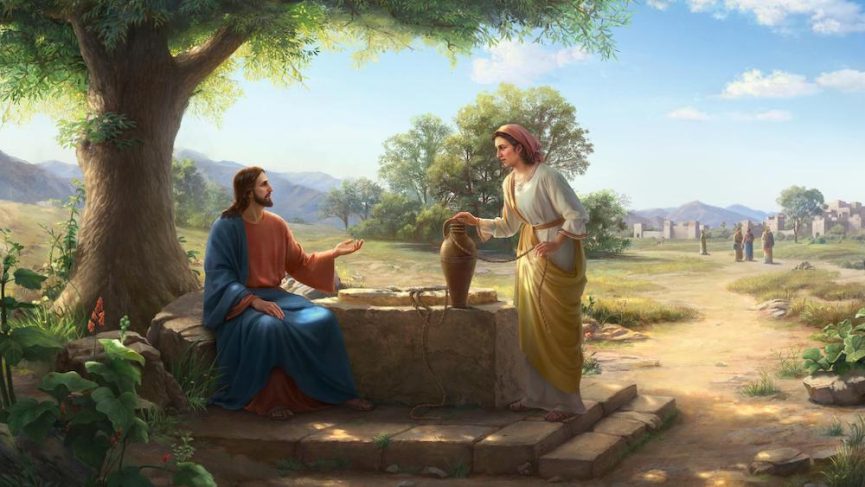
At the well Jesus meets a Samaritan woman and as usually happens in those occasions, immediately several barriers appear: Ethnic barrier – Jews and Samaritans did not associate; Gender barrier – rabbis normally did not speak publicly with women; Moral barrier – the woman had a complicated life history. But Jesus ignores all these barriers. He simply says: “Give me a drink.” When we think about this moment, we can see that it is a moment of humility. The Son of God asks a Samaritan woman for water. And as it is expected, she is shocked: “How is it that you, a Jew, ask me, a Samaritan woman, for a drink?” It is worthy to notice Jesus’ response: “If you knew the gift of God and who it is that asks you…” Can you see it? Jesus is not speaking to her as a Jew speaking to a Samaritan. He is speaking to her as the Messiah speaking to a human soul.
Jesus refuses to see this woman through the lens of hostility or prejudice. He sees her as someone loved by God. And that challenges us. Especially in these times when we are at war, because most of the time, we see people first through categories: We see them through theirs and our nationality, through theirs and our politics, through theirs and our religion, through theirs and our social status. But Jesus teaches us to see people… and never labels.
At the center of this conversation is a powerful image: water. The woman comes to the well to draw physical water. But Jesus offers something greater: “Whoever drinks the water I give will never thirst.” This is an exchange of waters moment. She comes for ordinary water. Jesus offers living water. Water from the well satisfies temporarily. But the living water of Christ satisfies the deepest thirst of the human soul. Thirst for unity, thirst for peace. Thirst of living in harmony. As Nicodemus did in the previous chapter. The woman begins the conversation misunderstanding Jesus, thinking about physical buckets and wells. But Jesus is speaking about grace, life, and transformation.
Something remarkable happened during this exchange of water. The woman who came to draw water from a well, ended drawing from the living source, Jesus and she became someone who carries living water to others. After the conversation ended, she runs back to the town with a simple message: “Come and see a man who told me everything I have ever done.” The woman becomes the first evangelist to her community, and many came to Jesus. This spiritual revival in Samaria did not begin with singing for hours and days, it begun with Jesus’ humiliation, with Jesus removing labels, and with Jesus -a Jew- giving up his racial pride.
Third lesson. Jesus even changed the way of Worship
The woman raises the ancient debate: “Our ancestors worshiped on this mountain, but you Jews say that the place to worship is Jerusalem.” For centuries Jews said Jerusalem was the proper place of worship. Samaritans said Mount Gerizim was the correct place. This was a theological argument tied to identity and history… and why not… stubbornness too. But Jesus answers to the woman in a revolutionary way: “A time is coming when you will worship the Father neither on this mountain nor in Jerusalem… true worshipers will worship the Father in spirit and truth.”
Did you notice, Jesus shifts the conversation entirely. The question is not where to worship. The question is how you worship. True worship is not defined by geography or tradition. True worship is defined by a heart connected to God. This was radical. Jesus was breaking centuries of religious division. He was announcing a new reality where access to God was no longer controlled by sacred locations. Through Him, Jesus, God becomes accessible everywhere. Later in the Book of Acts God sent the Holy Spirit to those in Samaria too.
This story, sisters and brothers, is not only about our Christians past…if that is the case… It is also about our present. Our world is full of divisions: nations divided against nations, peoples divided because of their culture, political groups divided against each other, communities divided by suspicion and fear, and because of this people often label others as enemies. But the followers of Christ are called to something different. Just like the Samaritan woman, we are called to be carriers of living water.
We are called to bring the presence of Christ into spaces of hostility, to bring peace where there is conflict, to bring reconciliation where there is division. The living water we receive from Christ is not meant to stay in our hearts alone. It must flow outward into the world. John 7:38, “Whoever believes in me, as Scripture has said, rivers of living water will flow from within them.”
This encounter at the well reminds us of several things: Christians must continue crossing barriers. Jesus’ follower must see people not labels. We must offer living water to everyone. Jesus calls us to bring peace to those we once considered enemies.
The woman came to the well carrying an empty jar. But she left carrying good news for her whole town. And the question for us today is simple: Are we willing to follow Jesus into places where barriers exist? Are we willing to see others the way Christ sees them? Are we willing to carry the living water of Christ into a divided world?
Remember, Jesus crossed the barrier and offered living water to a divided people. And now that living water has been placed in us. We are jars of clay carrying the treasure of Christ. In a world divided by hatred, fear, and wars, God has chosen fragile vessels like us to carry a message strong enough to heal the world. The world is still thirsty. And Jesus is still the source of living water, are we willing to carry the living water?